
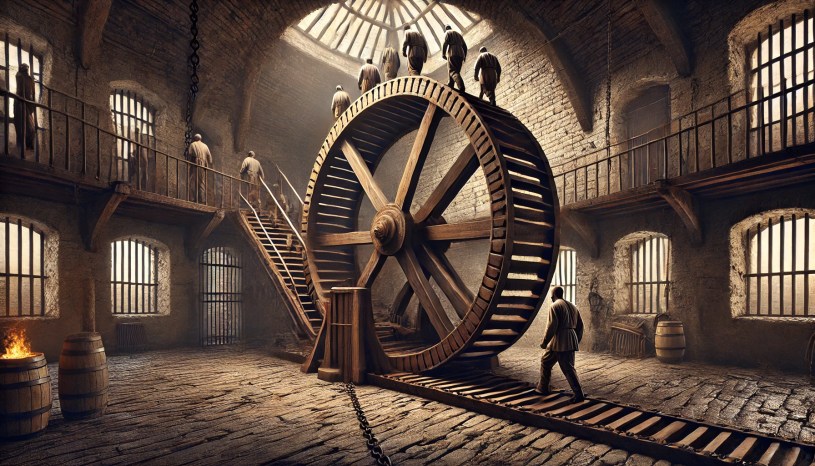
The treadmill has a fascinating origin, with roots that date back centuries before it became the staple piece of exercise equipment we know today. Its history intertwines with labor, punishment, and eventually fitness innovation. Here’s a concise overview of its evolution:
Ancient Beginnings
The earliest concept of a treadmill dates back to ancient times when it was used as a tool to harness human or animal power. In civilizations like Rome, treadmills were employed to lift heavy objects or operate machinery, such as water pumps or grain mills. These devices, called “treadwheels,” were large wooden structures operated by people walking inside or alongside them.
Industrial Revolution and Penal Use
The treadmill’s darker chapter began in the early 19th century when it was adapted as a form of punishment in British prisons. Engineer Sir William Cubitt designed the “prison treadmill” in 1818, intending to reform prisoners through hard labor. Inmates walked on a rotating belt that powered grain mills or pumped water. This grueling work was monotonous and exhausting, often lasting up to 10 hours a day.
The prison treadmill became a symbol of punishment and was widely used in Britain and other countries until it was phased out by the late 19th century due to humanitarian concerns.
Transformation into Fitness Equipment
The treadmill’s modern evolution began in the mid-20th century when it transitioned from a labor tool to a health and fitness device. Dr. Robert Bruce and Dr. Wayne Quinton developed the first medical treadmill in the 1950s for cardiac stress testing. This innovation marked the shift toward using treadmills to improve health rather than enforce punishment.
By the 1960s and 1970s, companies like Aerobics Inc. and Precor began producing treadmills for home and gym use. With advancements in technology, treadmills became increasingly sophisticated, featuring adjustable speeds, inclines, and digital displays.
Modern Popularity
Today, the treadmill is one of the most popular pieces of exercise equipment worldwide. It caters to diverse fitness goals, from rehabilitation to endurance training. Innovations like shock-absorbing decks, virtual reality integrations, and interactive workouts have made it a versatile and user-friendly option.
The treadmill’s journey from an ancient labor tool to a modern fitness staple reflects its adaptability and enduring utility, proving its value across centuries and contexts.
Have an origin story you want to know more about? Send your request to contact.origin.zone@gmail.com and submit your idea and be recognized in future posts.
 The Origin Zone