
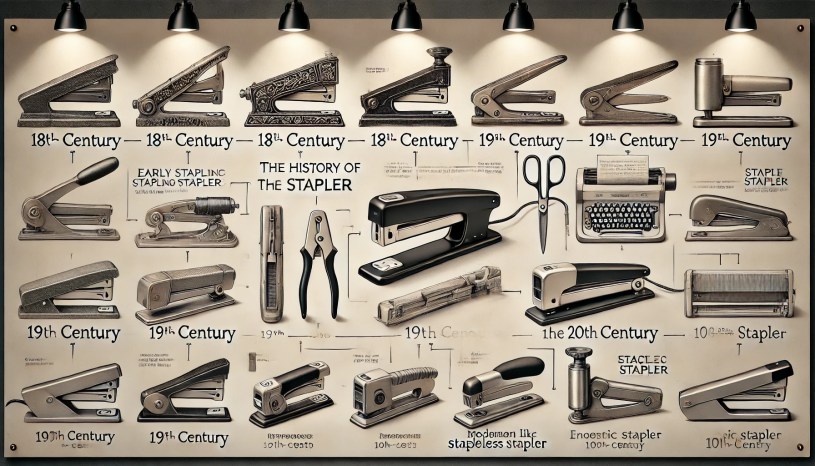
The stapler, a small but essential office tool, has a surprisingly rich and fascinating history. Its origin story is tied to the evolution of paperwork, bureaucracy, and the need for efficiency in document management.
The Early Beginnings
The concept of fastening papers together dates back centuries. Before the stapler, people used ribbons, pins, or wax seals to bind documents. However, these methods were often fragile or time-consuming.
The first significant step toward the modern stapler occurred in 18th-century France. Legend has it that King Louis XV used a device to bind royal documents. Each staple was handcrafted and bore the king’s insignia—an extravagant solution befitting royalty but impractical for wider use.
19th-Century Innovations
The Industrial Revolution spurred advancements in manufacturing, leading to the creation of more practical paper-fastening tools. In 1866, George McGill patented a small device for inserting brass paper fasteners. By 1879, McGill refined his design, creating a press-style stapler that could drive a staple through paper and bend its ends to secure it.
Despite this invention, staplers remained bulky and required pre-loaded staples. They were useful but not yet ideal for widespread office use.
The Modern Stapler Takes Shape
The turning point came in 1937 when Jack Linsky, an inventor and entrepreneur, patented the Swingline stapler. It featured a magazine-style design, allowing staples to be loaded in strips rather than one at a time. Linsky’s innovation made staplers easier to use and more affordable, transforming them into a staple (pun intended) of office life.
The Stapler Today
Modern staplers have continued to evolve, incorporating ergonomic designs, electronic models, and environmentally friendly materials. From classrooms to corporate offices, they remain indispensable tools.
Final Thoughts
The stapler’s journey from royal luxury to an everyday necessity reflects humanity’s drive to simplify tasks and improve efficiency. It’s a humble reminder that even the smallest tools can have monumental impacts on productivity and organization.
Have an origin story you want to know more about? Send your request to contact.origin.zone@gmail.com and submit your idea and be recognized in future posts.
 The Origin Zone