
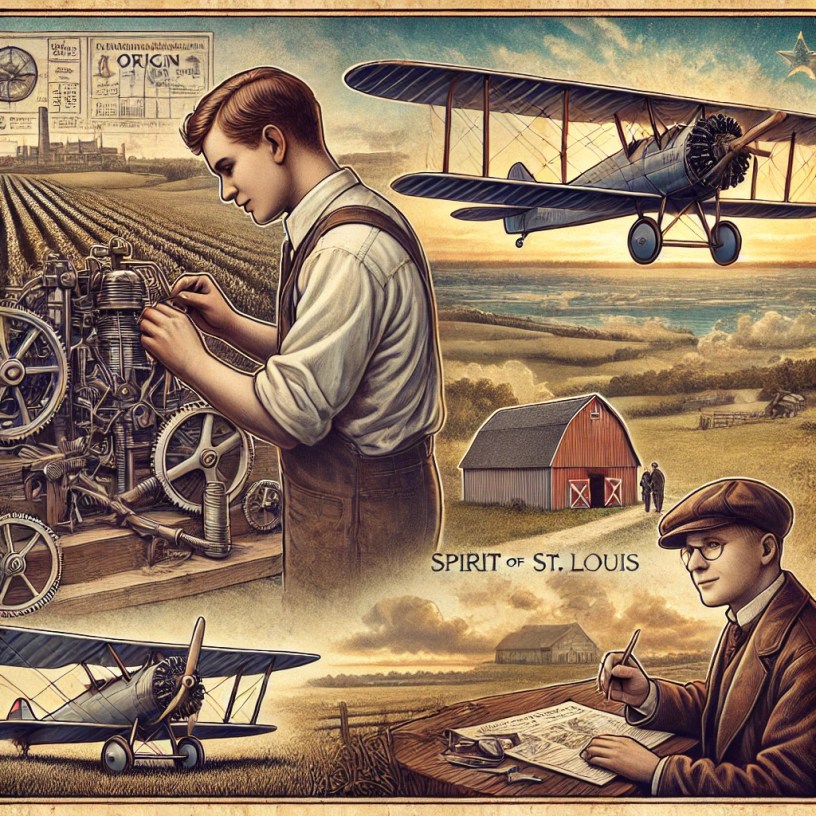
Charles Lindbergh’s origin story is one of adventure, innovation, and a profound mark on the history of aviation. Born on February 4, 1902, in Detroit, Michigan, Lindbergh grew up in a world on the cusp of the modern era, when automobiles and airplanes were just beginning to reshape the way people lived and traveled.
Early Life and Fascination with Mechanics
Lindbergh was raised primarily in Little Falls, Minnesota, where he developed an early fascination with machines. His father, Charles August Lindbergh, was a lawyer and U.S. Congressman, while his mother, Evangeline Lodge Land Lindbergh, was a chemistry teacher who encouraged his curiosity. From an early age, Charles displayed a knack for mechanics, often tinkering with cars and engines on the family farm. His practical mind and adventurous spirit hinted at the bold path he would later pursue.
Flight Training and Early Career
Lindbergh’s journey into aviation began in 1922 when he enrolled in flying school in Nebraska. He was captivated by the idea of flying and worked hard to master the skills needed to pilot aircraft. To fund his training, he barnstormed across the Midwest, performing daring aerial stunts and serving as an airmail pilot. This early experience not only honed his flying skills but also gave him a reputation as a skilled and daring aviator.
The Spirit of St. Louis and the Transatlantic Challenge
By the mid-1920s, Lindbergh was determined to achieve something extraordinary. He set his sights on the Orteig Prize, a $25,000 reward offered to the first aviator to complete a nonstop flight between New York and Paris. Backed by a group of St. Louis businessmen, Lindbergh commissioned the construction of a single-engine monoplane, the Spirit of St. Louis.
On May 20-21, 1927, at the age of 25, Lindbergh took off from Roosevelt Field in New York and flew solo across the Atlantic Ocean, landing 33.5 hours later at Le Bourget Field near Paris. His daring flight made him the first person to accomplish the feat, earning him international acclaim and solidifying his place in history.
Legacy and Later Life
Lindbergh’s transatlantic flight not only advanced the field of aviation but also inspired a generation of pilots and engineers. However, his life after the historic flight was marked by both triumph and controversy. He became a global celebrity, advocating for aviation advancements, but his involvement in political and social issues, including his stance on U.S. neutrality before World War II, drew criticism.
Despite these complexities, Lindbergh remained a pioneer and innovator. His contributions to aviation, environmental conservation, and technological advancement left an indelible mark on the 20th century.
Charles Lindbergh’s story is a testament to human courage, ingenuity, and the enduring quest to push the boundaries of what is possible.
Have an origin story you want to know more about? Send your request to contact.origin.zone@gmail.com and submit your idea and be recognized in future posts.
 The Origin Zone