
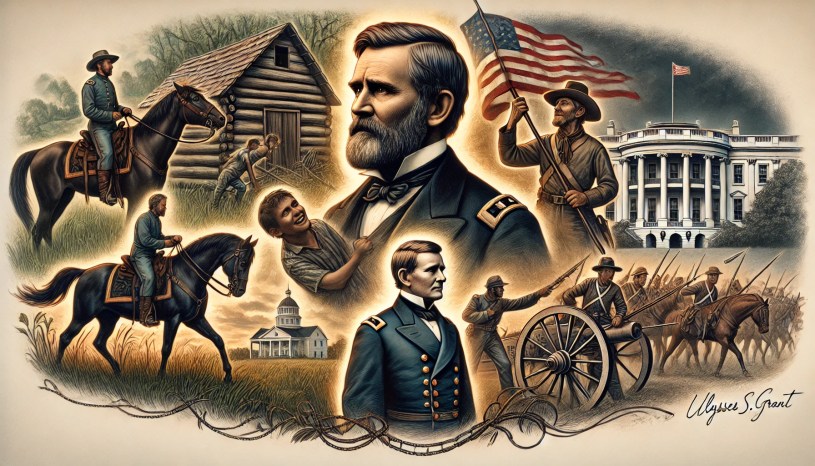

The Origin Story of Ulysses S. Grant: From Obscurity to Greatness
Ulysses S. Grant’s journey to becoming one of America’s most celebrated generals and the 18th president of the United States is a story of resilience, modesty, and quiet determination. Born Hiram Ulysses Grant on April 27, 1822, in Point Pleasant, Ohio, Grant was the eldest of six children. His upbringing was humble, and his path to greatness was far from straightforward.
Early Life and West Point
Grant’s father, Jesse Root Grant, was a tanner and businessman, while his mother, Hannah Simpson Grant, was a reserved and devout woman. Young Ulysses grew up working on the family farm and quickly developed a reputation for his exceptional horsemanship. This natural skill would later become one of his defining characteristics as a military leader.
At 17, Grant was nominated to attend the United States Military Academy at West Point. Due to a clerical error, his name was listed as Ulysses S. Grant—a name he adopted for the rest of his life. Though he excelled in mathematics and demonstrated a talent for riding, he was an average student overall, graduating 21st out of 39 cadets in 1843.
Early Military Career and Struggles
After West Point, Grant served in the Mexican-American War under Generals Zachary Taylor and Winfield Scott. He gained valuable combat experience and developed a pragmatic view of military strategy. However, peacetime military life did not suit Grant. He struggled with boredom and bouts of homesickness, which some biographers suggest contributed to his rumored struggles with alcohol.
By 1854, Grant resigned from the army and returned to civilian life. The next several years were marked by financial struggles and a series of failed ventures, including farming and real estate. By the time the Civil War broke out in 1861, Grant was working in his father’s leather shop in Galena, Illinois, far removed from the life of a soldier.
The Civil War: A Reluctant Hero
When the Civil War began, Grant offered his services to the Union Army. Despite his modest reputation and years away from military service, he quickly rose through the ranks. His decisive victories at Fort Donelson, Shiloh, and Vicksburg demonstrated his ability to adapt, endure, and achieve results under pressure.
Grant’s success was rooted in his tenacity and a willingness to press the attack when others might have hesitated. His ability to endure criticism and focus on the larger picture earned him the trust of President Abraham Lincoln, who appointed him commander of all Union armies in 1864.
Presidency and Later Years
Following his triumphs in the war, Grant was seen as a national hero and was elected president in 1868. His two terms were marked by efforts to rebuild the South during Reconstruction and to promote civil rights for freed African Americans. However, his administration was also marred by scandals and corruption among his appointees.
After leaving office in 1877, Grant faced financial ruin once again due to bad investments. Determined to provide for his family, he turned to writing his memoirs, which were published by his friend Mark Twain. Completed just days before his death in 1885, the Personal Memoirs of Ulysses S. Grant remains one of the greatest works of American military history.
A Legacy of Resilience
Grant’s life was marked by setbacks, but his ability to rise above them is what made him a figure of enduring significance. From a struggling farmer to a victorious general and president, Ulysses S. Grant’s story is a testament to perseverance and the belief that greatness can emerge from the humblest beginnings.
Have an origin story you want to know more about? Send your request to contact.origin.zone@gmail.com and submit your idea and be recognized in future posts.
 The Origin Zone