

The Sweet History of Ice Cream: A Delicious Origin Story
Ice cream is one of the world’s most beloved desserts, but its origins stretch far back into history, long before modern freezers and ice cream parlors existed. The story of ice cream is a journey across cultures, continents, and centuries, evolving from simple frozen treats to the creamy delight we enjoy today.
Ancient Beginnings: The First Frozen Treats
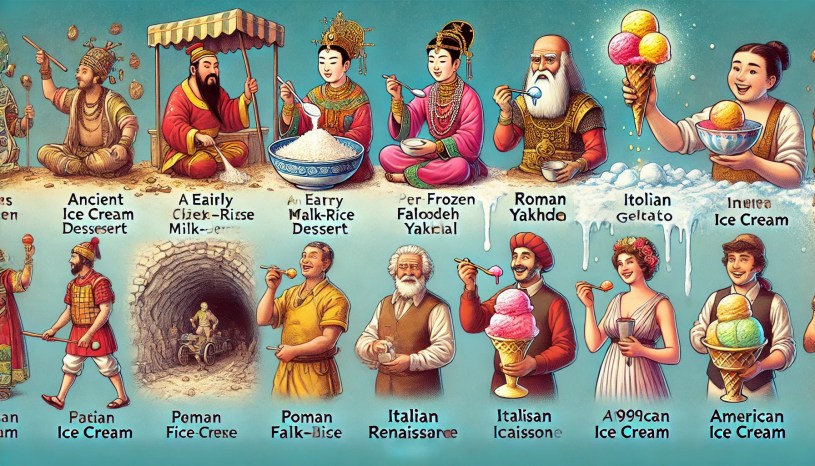
The earliest versions of ice cream can be traced back to ancient civilizations. Around 200 BCE, the Chinese are believed to have created a frozen mixture of milk and rice, cooled with packed snow. Meanwhile, in Persia (modern-day Iran), people enjoyed a chilled dessert called faloodeh, made with vermicelli noodles, rose water, and frozen syrup, stored in underground refrigeration chambers known as yakhchals.
The Greeks and Romans also had their own take on early ice cream. The famous Roman Emperor Nero (37–68 CE) reportedly sent his slaves to the mountains to gather snow, which was then flavored with fruit juices and honey. Similarly, Alexander the Great was known to enjoy snow mixed with honey and nectar.
The Evolution of Ice Cream in the Middle Ages
Ice cream as we recognize it today began to take shape during the Middle Ages. Arab traders introduced sharbat (the precursor to sherbet) to Europe, a sweet, flavored ice drink that inspired many later frozen desserts. The technique of using sugar in frozen treats became more refined in the Middle East and later spread to Italy.
One of the biggest turning points came in the 13th century when Marco Polo returned from China, bringing knowledge of frozen milk-based treats. This knowledge eventually influenced Italian chefs, leading to the development of gelato.
Ice Cream Spreads Across Europe
During the Renaissance, ice cream became a delicacy in European courts. In the 16th century, Catherine de’ Medici of Italy introduced gelato to the French court when she married King Henry II. Later, in the 17th century, King Charles I of England supposedly enjoyed an exclusive recipe for “cream ice,” ensuring that only the royal family could indulge in this luxury.
By the late 1600s, ice cream became more accessible. In 1686, Francesco Procopio dei Coltelli, an Italian chef, opened Café Procope in Paris, one of the first establishments to serve ice cream to the public. His recipes helped spread the popularity of ice cream throughout Europe.
Ice Cream in the New World
Ice cream made its way to the American colonies in the 18th century. It became a favorite treat among the wealthy, with figures like George Washington and Thomas Jefferson known to have enjoyed it. Jefferson even had a personal recipe for vanilla ice cream, which he brought back from France.
However, it wasn’t until the 19th century that ice cream became widely available. The invention of insulated ice houses and the hand-cranked ice cream churn, patented by Nancy Johnson in 1843, made production easier. Soon, ice cream parlors began popping up across the U.S.
The Industrial Revolution and Mass Production
The true democratization of ice cream happened during the Industrial Revolution. In the late 19th century, advancements in refrigeration made it possible to produce and store ice cream on a large scale. Companies like Breyers and Ben & Jerry’s would later emerge, making ice cream a household staple.
The 20th century saw the rise of iconic ice cream innovations, including the ice cream cone (popularized at the 1904 St. Louis World’s Fair), the introduction of soft serve in the 1930s, and the invention of the ice cream sundae and banana split.
Modern Ice Cream: Endless Flavors and Forms
Today, ice cream is a global phenomenon, with countless variations from gelato and sorbet to mochi ice cream and nitrogen-frozen creations. It remains a symbol of joy, nostalgia, and creativity, evolving with new flavors, dietary options, and innovations.
From its humble beginnings as frozen snow mixed with honey to the creamy, indulgent treat we love today, ice cream has a rich and delicious history. No matter how you enjoy iton a cone, in a cup, or straight from the tub every scoop carries centuries of tradition and craftsmanship.
 The Origin Zone