
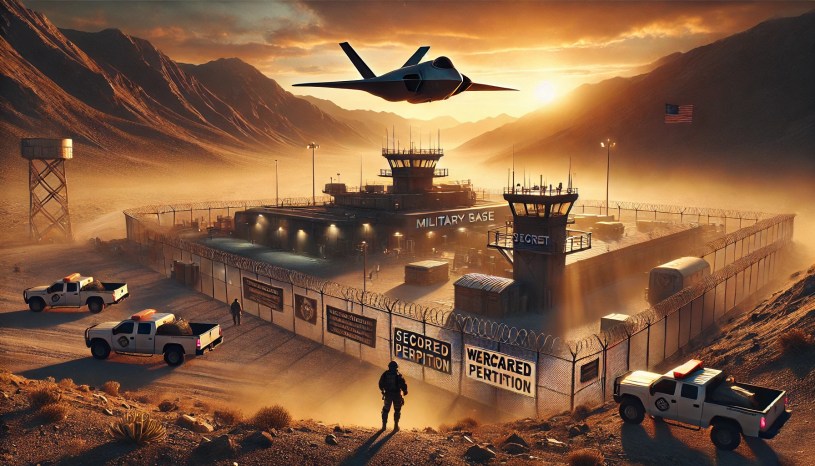

The Mysterious Origins of Area 51: A Secret Born in the Desert
Deep in the Nevada desert, where the sun scorches the land by day and the stars seem to whisper secrets at night, lies one of the most infamous military installations in history—Area 51. Its name alone sparks curiosity, speculation, and a whirlwind of conspiracy theories. But how did this secretive site come to be?
A Desert Base with a Cold War Purpose
The story of Area 51 begins in the early 1950s, at the height of the Cold War. The United States and the Soviet Union were locked in a silent but deadly game of espionage, each trying to outmaneuver the other in the race for technological superiority. In this climate of paranoia and secrecy, the U.S. military sought a remote, isolated location to test advanced aircraft—some so cutting-edge that they seemed almost otherworldly.
Enter Groom Lake, a dry salt flat in the Nevada desert. Surrounded by mountains and far from prying eyes, it was the perfect location for a top-secret airfield. In 1955, the Central Intelligence Agency (CIA) and the U.S. Air Force established the facility under the codename “Paradise Ranch”, hoping the appealing name would attract top engineers and pilots to work on classified projects.
The Birthplace of Spy Planes
The first major project at Area 51 was the development of the Lockheed U-2 reconnaissance aircraft. Designed to fly at extreme altitudes beyond the reach of Soviet radar and anti-aircraft missiles, the U-2 was a game-changer in intelligence gathering. However, test flights led to an unexpected problem—civilian and military pilots frequently reported sightings of strange, fast-moving objects in the sky. These reports fueled UFO rumors, as the existence of the U-2 was classified.
Following the U-2 program, Area 51 became the testing ground for even more advanced aircraft, including the A-12 Oxcart, the SR-71 Blackbird, and later, the F-117 Nighthawk stealth fighter. Each of these aircraft pushed the limits of aviation technology, reinforcing the base’s reputation as a cradle of innovation—and secrecy.
The UFO Connection
Area 51’s intense secrecy and restricted access naturally led to speculation. The government’s refusal to acknowledge the base for decades only fueled the fire. The 1989 claims of Bob Lazar, who alleged he worked on reverse-engineering alien spacecraft at a site near Area 51, catapulted the base into pop culture as the supposed home of extraterrestrial technology. While no hard evidence has ever surfaced to support such claims, the connection between Area 51 and UFO lore remains unbreakable.
Official Recognition and Continued Secrecy
For decades, the U.S. government denied the existence of Area 51. It wasn’t until 2013 that the CIA officially declassified documents acknowledging its role in Cold War aircraft testing. However, while we now know the base exists, what happens inside remains a closely guarded secret.
Even today, the facility is shrouded in mystery. Surveillance is tight, with warning signs, motion sensors, and armed security forces patrolling the perimeter. Satellite images reveal a constantly evolving infrastructure, suggesting that cutting-edge research continues within its boundaries.
Conclusion: A Legacy of Mystery
Area 51’s origins are rooted in the necessity of national security, but its legacy is one of intrigue, secrecy, and speculation. Whether it’s the birthplace of futuristic aircraft, a hub for clandestine military experiments, or the hiding place of alien technology, one thing is certain—the legend of Area 51 is here to stay.
What do you think? Is Area 51 simply a testing ground for advanced technology, or is there something even more mysterious hidden within its desert expanse?
 The Origin Zone