
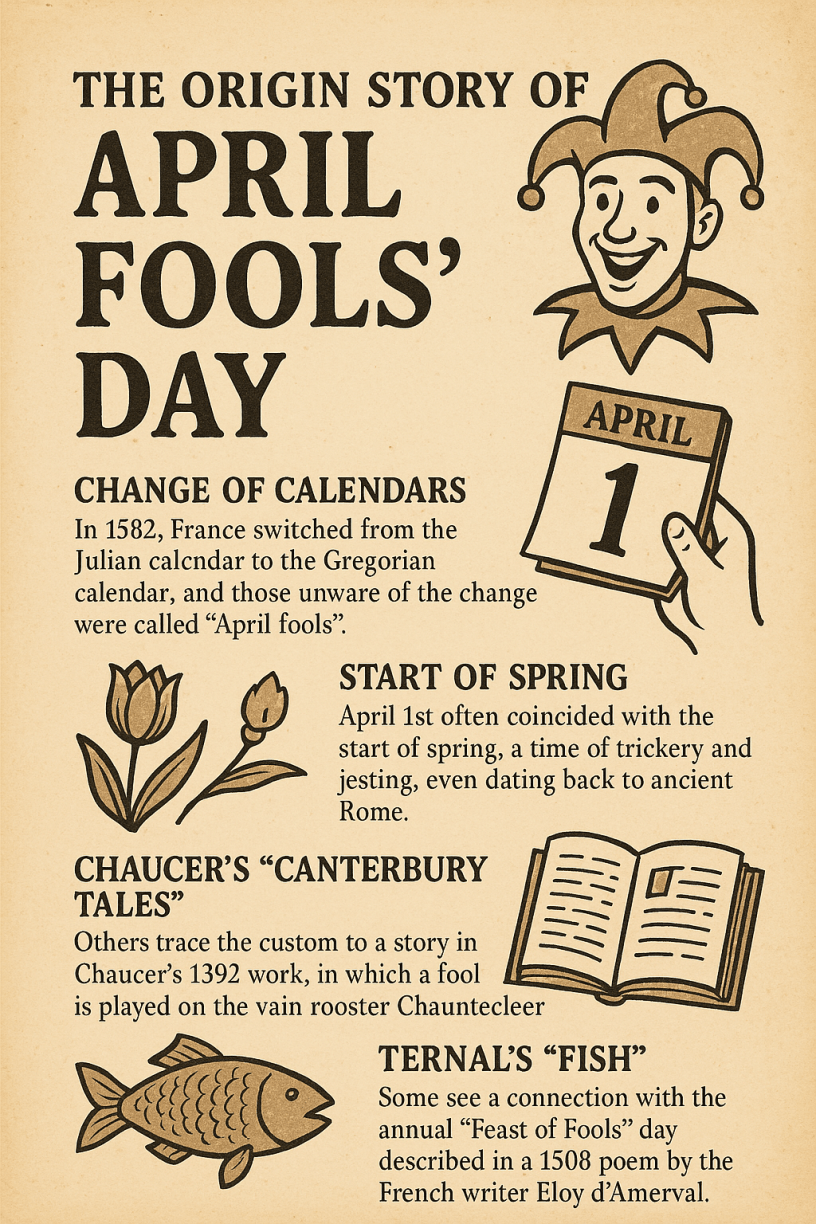
Every year on April 1st, people across the world engage in a time-honored tradition of pranks, hoaxes, and lighthearted deception. But have you ever wondered how this mischievous holiday came to be? While the true origins of April Fools’ Day remain somewhat of a mystery, historians have pieced together several compelling theories that trace the roots of this playful celebration.
A Calendar Confusion
One of the most widely accepted theories about the origins of April Fools’ Day dates back to the late 16th century when France adopted the Gregorian calendar in 1582. Before this change, the new year was celebrated around the end of March or early April. Those who failed to recognize the new date and continued celebrating the old New Year were mockingly referred to as “April fools.” People would play pranks on them, such as sticking paper fish on their backs, a tradition that still exists in France today, known as “Poisson d’Avril” (April Fish).
Ancient Festivals of Fools
Another theory links April Fools’ Day to ancient traditions that embraced chaos and humor. The Roman festival of Hilaria, celebrated at the end of March, was a day of rejoicing, masquerades, and playful deceptions. Similarly, medieval Europe had a “Feast of Fools,” during which societal norms were temporarily overturned, and jesters reigned supreme. These traditions may have evolved into the modern practice of pranking.
The Spread Through Literature and Media
Literary references to April Fool’s Day date back centuries, with one of the earliest mentions appearing in Geoffrey Chaucer’s The Canterbury Tales (1392). In “The Nun’s Priest’s Tale,” Chaucer makes a reference to “32 March,” an apparent joke that some interpret as an early nod to April 1st. Later, newspapers, radio stations, and even corporations embraced the holiday, further embedding it into popular culture. One of the most famous hoaxes occurred in 1957 when the BBC aired a segment about Swiss farmers harvesting spaghetti from trees, fooling many viewers.
A Day for Lighthearted Fun
Despite the uncertainty surrounding its exact origins, April Fools’ Day endures as a global tradition that allows people to momentarily step away from the seriousness of life and embrace humor. Whether it’s an elaborate prank or a simple joke, the holiday serves as a reminder that laughter is a universal language.
So, the next time you find yourself on the receiving end of a prank, remember—you’re taking part in a centuries-old tradition of fun and folly. Happy April Fools’ Day!
 The Origin Zone