
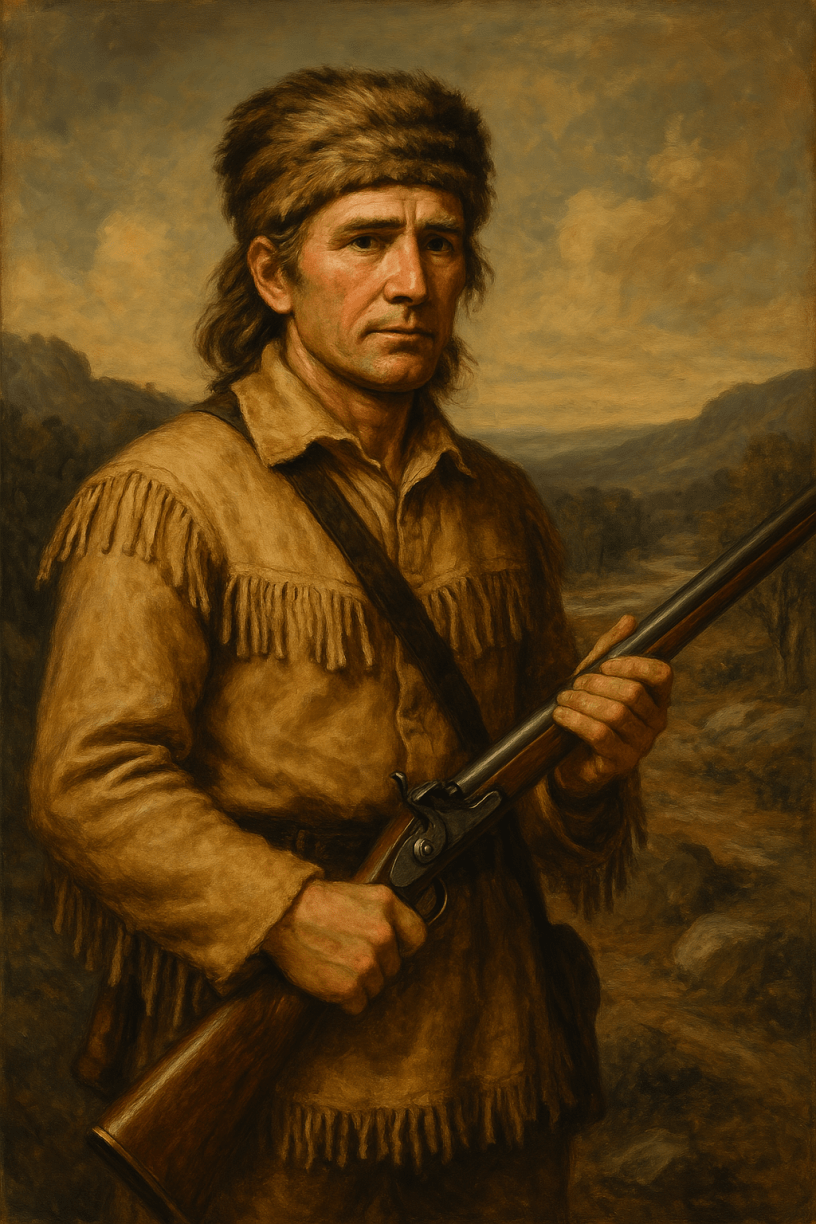

The Real Origins of Davy Crockett: Frontier Statesman and American Icon
David Crockett was born on August 17, 1786, in a small cabin near the Nolichucky River in what was then the western frontier of North Carolina (now Tennessee). He was the fifth of nine children born to John and Rebecca Crockett, a Scotch-Irish family of modest means who eked out a living through farming, hunting, and operating taverns.
Crockett’s early life was marked by hardship and self-reliance. His father struggled financially, often moving the family in search of better opportunities. At the age of 12, after a disagreement with a schoolmaster and fearing punishment at home, young Davy ran away and spent over two years on his own. During this time, he supported himself by working for farmers and drovers, gaining a reputation for independence and frontier skill.
By 1806, Crockett had returned home, married Mary Finley, and began building a life as a farmer and hunter in East Tennessee. His success in the wilderness—especially his proficiency as a marksman and scout—earned him respect among fellow settlers. After serving as a militiaman in the Creek War (1813–1814) under Andrew Jackson, Crockett became more involved in local politics.
In the 1820s, Crockett’s political career began in earnest. He served in the Tennessee state legislature before being elected to the U.S. House of Representatives in 1827. In Washington, he gained national attention for his colorful speech, homespun mannerisms, and strong advocacy for squatters’ rights and self-sufficient settlers. Notably, he opposed President Andrew Jackson’s Indian Removal Act, a stance that eventually cost him political support and led to the loss of his congressional seat.
Frustrated by politics and the direction the country was heading, Crockett set out for Texas, then a Mexican territory in the midst of revolution. He arrived in early 1836 and joined the fight for Texan independence. Just weeks later, he died at the Battle of the Alamo on March 6, 1836, alongside approximately 180 defenders.
Though his life became romanticized in the decades that followed—through plays, biographies, and 20th-century television—the historical Davy Crockett was a self-made man, a skilled woodsman, and a complex figure who stood by his principles, even when they proved politically costly. His legacy straddles the line between fact and folklore, but his role as a symbol of the American frontier endures.
 The Origin Zone