
The Paper Clip: A Deep Dive Into a Small Wonder
At first glance, the paper clip seems like a simple tool—a bent wire used to hold papers together. But its story is anything but simple. This iconic piece of office equipment is a marvel of minimalist engineering, with a rich and surprising history.
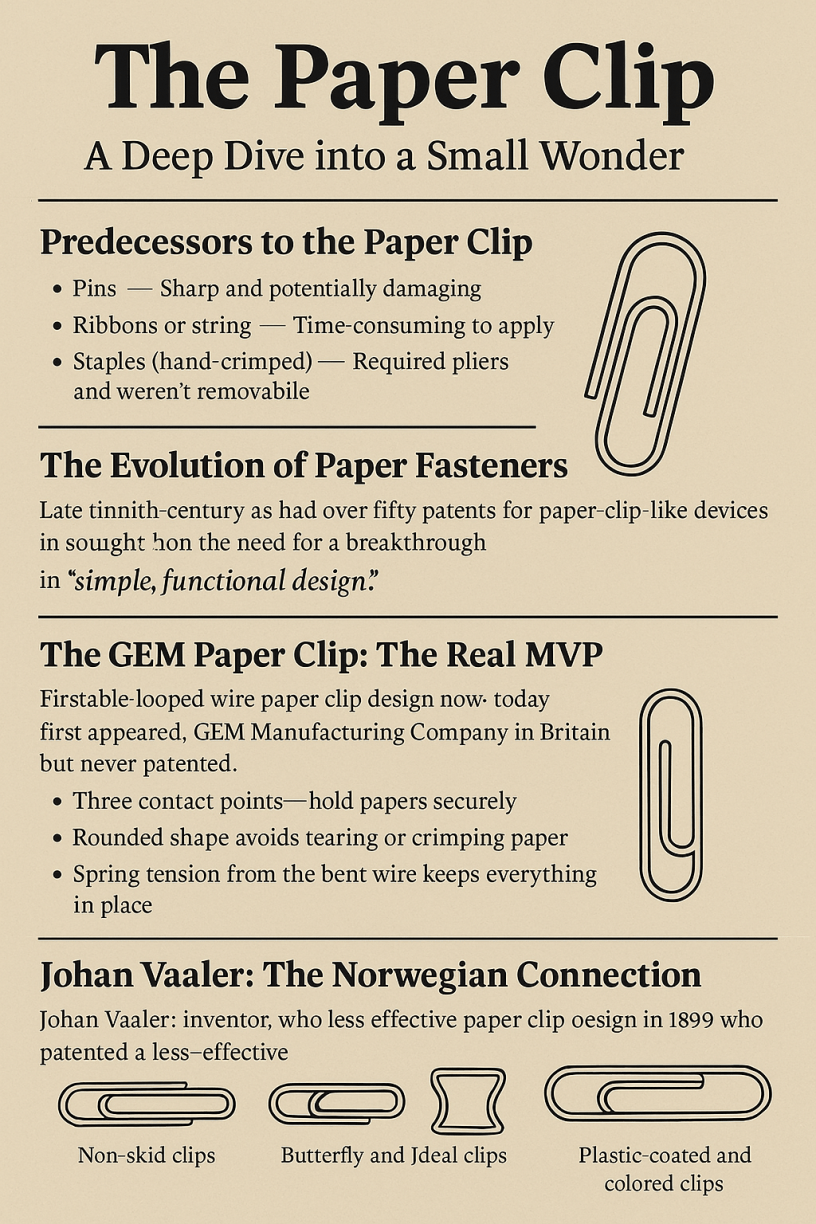
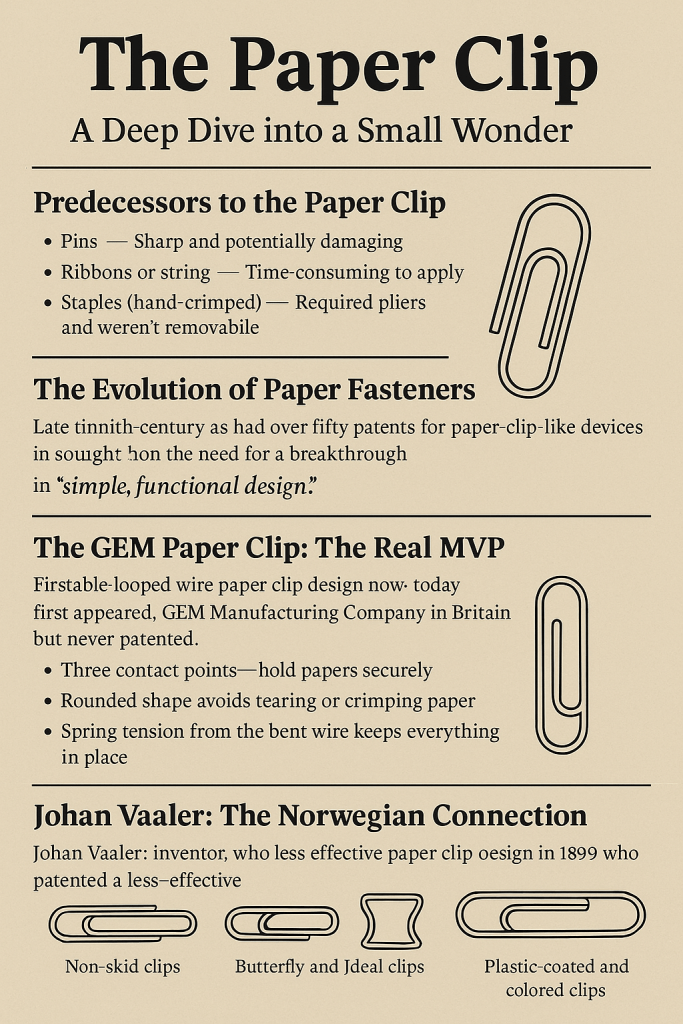
Predecessors to the Paper Clip
Before the paper clip became standard, people used a variety of methods to bind papers:
- Pins: Sharp and potentially damaging to documents.
- Ribbons or string: Time-consuming to apply.
- Staples (hand-crimped): Early forms required pliers and weren’t removable.
The need was clear: something quick, reusable, non-damaging, and mass-producible.
The Evolution of Paper Fasteners
In the mid-to-late 1800s, inventors were busy experimenting with mechanical fasteners. Over 50 patents for paper clip-like devices were filed in the U.S. alone during this period. Designs varied—some were complex contraptions with multiple parts or required special tools to apply.
What the world needed was a breakthrough in simple, functional design.
The GEM Paper Clip: The Real MVP
The version we know and love today—the double-looped wire design—first appeared around the 1890s, manufactured by Gem Manufacturing Company in Britain. Though Gem never patented their design, it became the dominant standard because of its superior functionality:
- Three contact points hold papers securely.
- Rounded shape avoids tearing or crimping paper.
- Spring tension from the bent wire keeps everything in place.
Its elegance lies in its efficiency. It uses no adhesive, no heat, no extra tools—just the physical properties of steel wire bent in a particular way.
Johan Vaaler: The Norwegian Connection
In 1899 and 1901, Johan Vaaler, a Norwegian inventor, patented a paper clip design in Germany and the U.S. His version lacked the final inner loop that gives the Gem clip its superior grip. Though less effective, his story gained popularity during World War II when Norwegians embraced the paper clip as a symbol of resistance against Nazi occupation.
In modern Norway, the paper clip remains a cultural icon. A giant paper clip sculpture stands in Oslo to honor Vaaler’s spirit of innovation, even if his design wasn’t the most effective.
Design Variants and Materials
Though the Gem design is dominant, there have been countless variations:
- Non-skid clips: With serrated edges for more grip.
- Butterfly and Ideal clips: Used mainly in legal and archival settings.
- Plastic-coated and colored clips: For aesthetic or organizational purposes.
Most are made of galvanized steel wire, though some use brass or plastic to prevent rust or for decorative use.
Engineering Brilliance
The Gem paper clip demonstrates key principles of mechanical engineering:
- Elastic deformation: The clip flexes under pressure but returns to shape.
- Friction and tension: It grips papers without damaging them.
- Material efficiency: Minimal use of material, zero waste in manufacturing.
It’s a perfect example of “form follows function.”
Cultural Footnotes and Modern Fame
- Symbol of Resistance: In WWII Norway, wearing a paper clip was a subtle act of rebellion.
- Symbol of Minimalist Design: The paper clip is showcased in museums like the Museum of Modern Art (MoMA).
- Digital Legacy: Microsoft Office’s infamous assistant “Clippy” was modeled after it.
- Economic Wonder: Billions are made every year—cheap, effective, indispensable.
The paper clip is proof that innovation doesn’t always have to be flashy. Sometimes, the most brilliant inventions are the ones so well-designed, we barely notice them. It’s a triumph of industrial design—a small object that quietly holds our world together, one document at a time.
 The Origin Zone