
The Stretchy Story: How Rubber Bands Came to Be
Take a moment to look at the humble rubber band — a simple loop of stretchy material that’s probably holding together your mail, securing your ponytail, or gathering loose wires. It seems so basic, yet this tiny tool has a surprisingly rich and stretchy history.
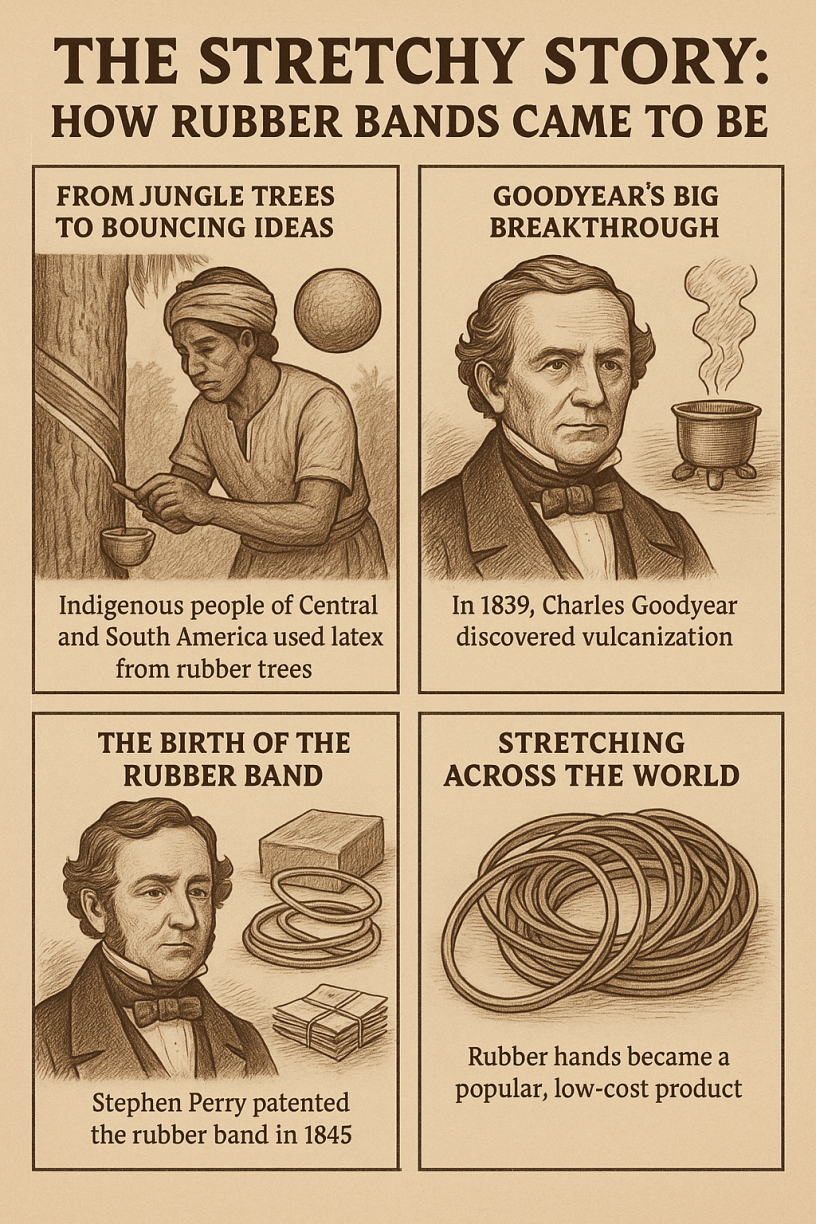
From Jungle Trees to Bouncing Ideas
The rubber band’s story starts deep in the rainforests of Central and South America, where indigenous people harvested latex from rubber trees (Hevea brasiliensis) for centuries. They used the sap to waterproof clothing and make balls that bounced — one of rubber’s earliest and most playful uses.
Enter the 19th century, and the Western world’s industrial imagination took hold. Natural rubber was bouncy and water-resistant but had a problem: it became brittle in the cold and gooey in the heat.
Goodyear’s Big Breakthrough
In 1839, Charles Goodyear accidentally discovered vulcanization — a process that involved heating natural rubber with sulfur. This transformed the sticky substance into something durable, elastic, and weather-resistant. It was a revolutionary moment for the rubber industry, opening the door to practical everyday uses.
The Birth of the Rubber Band
The specific invention of the rubber band came in 1845 when British inventor Stephen Perry, working for the rubber manufacturing firm Messrs. Perry & Co., received a patent for rubber bands made from vulcanized rubber. Perry’s vision was practical: he saw the need to bundle papers and items neatly and efficiently, especially in offices and homes. His stretchy invention was an instant hit.
Stretching Across the World
Rubber bands took off as a low-cost, high-utility product. With the rise of office work in the 20th century, demand skyrocketed. In 1923, William Spencer of Alliance, Ohio, founded the Alliance Rubber Company. Legend has it he started by cutting up rubber inner tubes and selling the bands to newspaper companies to wrap their papers. His company still operates today, a testament to the enduring usefulness of rubber bands.
A Modern Essential
Today, rubber bands are made from natural rubber or synthetic materials like silicone, and they come in all shapes, sizes, and colors. They hold together everything from vegetables to blueprints, and they even serve niche roles in orthodontics, agriculture, and aerospace engineering.
Not bad for a simple loop of rubber.
 The Origin Zone