
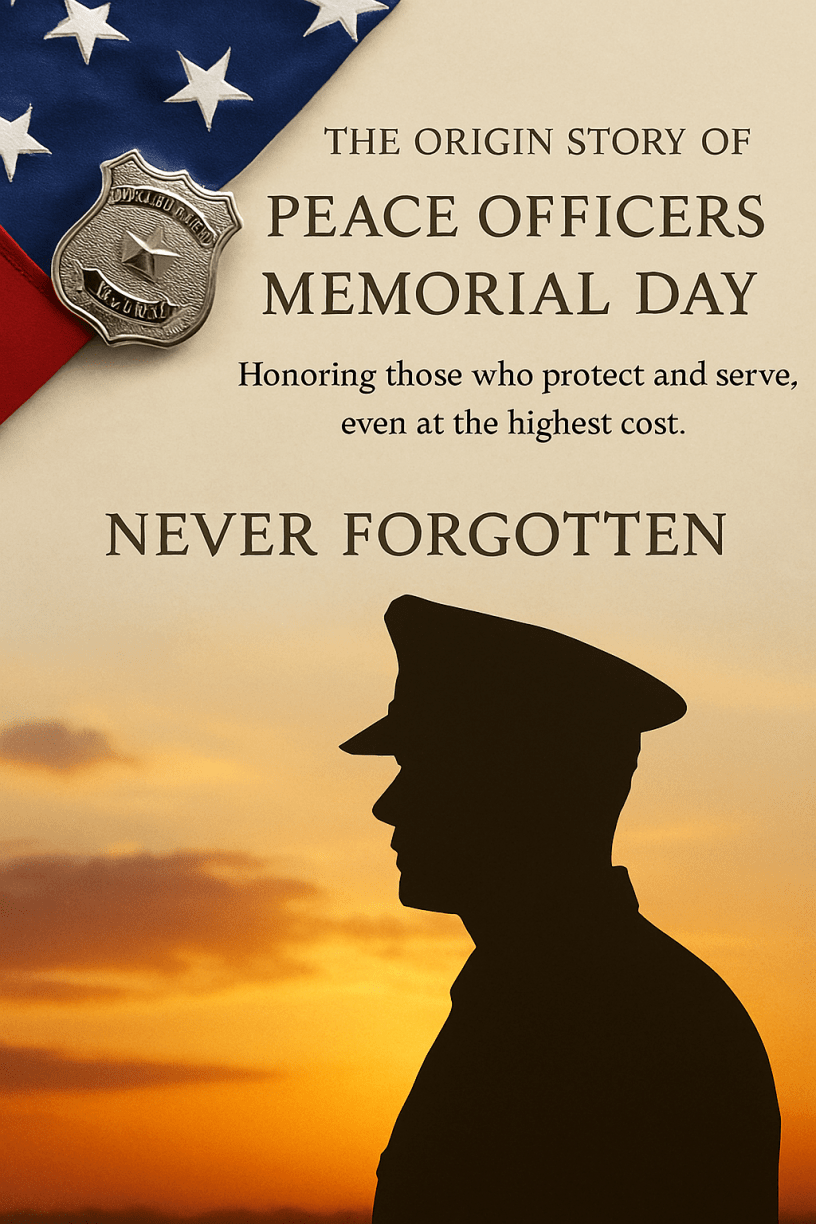

Origin Story of Peace Officers Memorial Day
Peace Officers Memorial Day, observed annually on May 15th, honors federal, state, and local law enforcement officers who have lost their lives in the line of duty. Its creation reflects a national recognition of the risks law enforcement officers take and the ultimate sacrifices many have made to protect their communities.
The Beginning
The origin of Peace Officers Memorial Day dates back to the early 1960s. Amid a growing awareness of the dangers faced by law enforcement officers, President John F. Kennedy signed a bill into law on October 1, 1962, designating May 15th as Peace Officers Memorial Day. The legislation was part of Public Law 87-726 and also established the week in which May 15 falls as National Police Week.
The Purpose
The goal was simple yet profound: to recognize and honor law enforcement officers who died or were disabled in the line of duty. In President Kennedy’s words, this observance serves “to pay tribute to the law enforcement officers who have made the ultimate sacrifice for our country and to voice our appreciation for all those who currently serve on the front lines of the battle against crime.”
Evolution Over Time
Since its inception, Peace Officers Memorial Day has evolved into a solemn tradition. In 1982, a more formal remembrance began when 120 survivors and supporters gathered in Washington, D.C., for the first organized memorial service. That service laid the groundwork for what would become the National Law Enforcement Officers Memorial and the annual events held during National Police Week.
The National Law Enforcement Officers Memorial Wall, dedicated in 1991, now bears the names of more than 20,000 officers killed in the line of duty. Each year, new names are engraved and formally honored during a candlelight vigil on May 13th, a key event of Police Week.
Today’s Observance
Peace Officers Memorial Day is marked by solemn ceremonies across the country. In Washington, D.C., the U.S. flag is flown at half-staff. Local communities, police departments, and survivor organizations hold events, memorial services, and moments of silence to honor the fallen and support their families.
What began as a single day of recognition has become a national movement of remembrance and solidarity. It stands not only as a day of tribute but as a reminder of the courage and commitment law enforcement officers display every day.
 The Origin Zone