
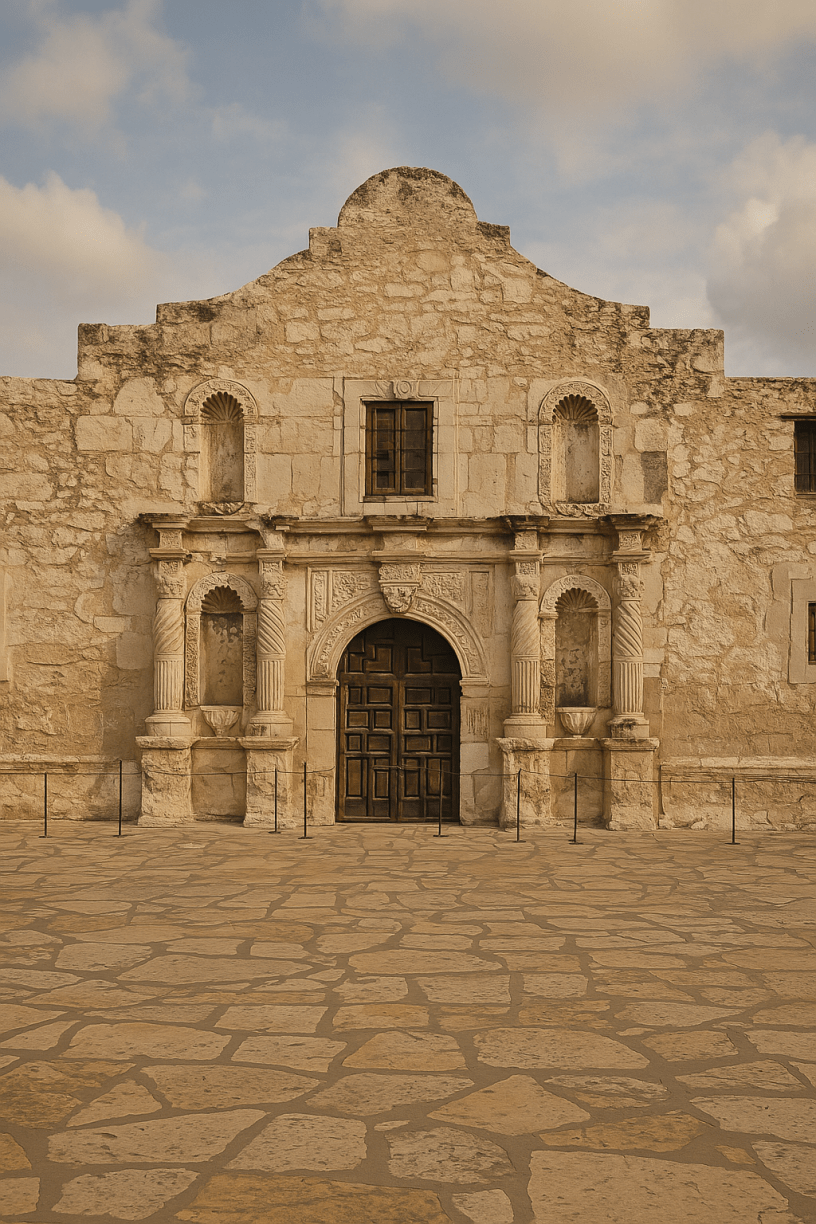

The Alamo: A Historical Origin Story
When most people hear the word Alamo, their minds jump to the dramatic 1836 battle—a desperate last stand that became a rallying cry for Texas independence. But long before cannon fire echoed off its stone walls, the Alamo was something entirely different: a Spanish mission born from colonial ambition and religious zeal.
This is the historical origin story of the Alamo—before the myth, before the fight, before the fall.
The Birth of a Mission
The story begins in 1718, when Spanish settlers and Franciscan missionaries arrived in what is now central Texas. Spain was expanding its northern frontier in the Americas, and missions were an essential part of their colonization strategy—designed to convert Native American populations to Christianity, teach European agricultural practices, and extend Spanish influence.
In May 1718, Mission San Antonio de Padua was founded near the San Antonio River. But by 1724, the mission was moved to a more permanent location and renamed Mission San Antonio de Valero, in honor of Saint Anthony of Padua and the Spanish viceroy at the time, the Marquis de Valero.
This mission would, over time, become known as the Alamo.
A Center of Conversion and Culture
For much of the 18th century, Mission San Antonio de Valero operated like many other Spanish missions across the region. It became home to numerous indigenous groups—mainly Coahuiltecan-speaking peoples—who were baptized, housed, and trained in trades such as farming, masonry, and weaving.
At its height, the mission supported a self-sufficient community. It had its own chapel, workshops, living quarters, and defensive structures to ward off raids. The stone church we now recognize as the Alamo was begun in the 1740s, though construction was never fully completed.
However, over time, the mission system began to decline. Disease, forced assimilation, and cultural suppression led to a shrinking Native population, and by the 1790s, many of the missions—including Valero—were secularized. That meant their religious function was phased out, and lands were redistributed.
From Faith to Fortification
By the early 1800s, Mission San Antonio de Valero was no longer a religious center—it was a strategic military post. In 1803, a Spanish cavalry unit known as the Second Flying Company of San Carlos de Parras occupied the old mission compound. These soldiers came from the town of Alamo de Parras in Coahuila, and they brought their hometown’s name with them.
The nickname “El Álamo” (Spanish for “the cottonwood”) stuck, inspired by both the unit’s origin and the cottonwood trees growing nearby.
The thick stone walls and central location made the former mission an ideal garrison. Over the next few decades, as control over Texas shifted from Spain to Mexico, and tensions grew between settlers and the Mexican government, the Alamo’s role as a military fort grew more important.
A Turning Point in Texas History
By the 1830s, Anglo-American settlers in Texas (then part of northern Mexico) began demanding more autonomy from the Mexican central government. Political unrest, cultural conflict, and dissatisfaction with Mexico’s leadership—especially under President Santa Anna—led to open rebellion.
In December 1835, Texian rebels (a mix of settlers and Tejanos who supported independence) captured the Alamo from Mexican forces during the Siege of Bexar. They fortified the compound, knowing Santa Anna would return.
Two months later, he did.
What followed was the legendary 13-day siege and the Battle of the Alamo, ending on March 6, 1836, with the death of all Texian defenders. Though the battle was a loss, it galvanized support for Texas independence—and gave birth to one of the most enduring mottos in American history: “Remember the Alamo!”
The Legacy of the Alamo’s Origins
Today, the Alamo is visited by millions of people every year. Most come to pay tribute to the brave fighters who died there. But fewer know the deeper story—the mission roots, the cultural crossroads, and the Spanish colonial ambitions that shaped its early years.
The Alamo didn’t start as a battlefield. It started as a place of faith, learning, and settlement—a complex site of history where religion, empire, and identity collided.
Understanding its full origin story helps us appreciate the Alamo not just as a symbol of a single battle, but as a witness to centuries of transformation—from sacred ground to historic shrine.
Remember the Alamo—but also remember where it began.
 The Origin Zone